

China and Canada Ease Tariffs After Key Meeting Between Carney and Xi

China and Canada Ease Tariffs After Key Meeting Between Carney and Xi
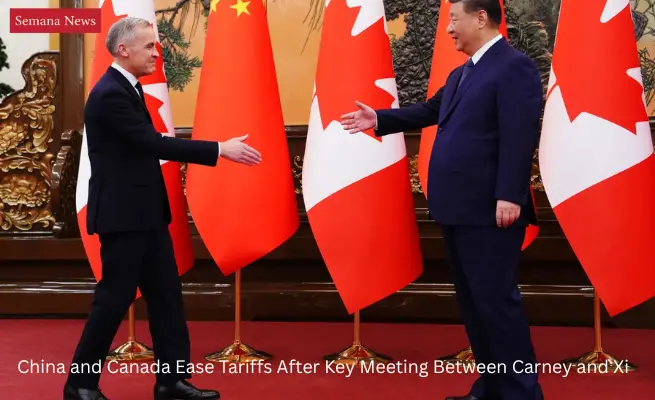
Chinese President Xi Jinping and Canadian Prime Minister Mark Carney have agreed to reduce tariffs following an important meeting in Beijing, signaling a fresh start in relations between the two countries.
China is expected to cut duties on Canadian canola oil from 85% to 15% by 1 March. In return, Canada will apply a most-favoured-nation (MFN) tariff rate of 6.1% on Chinese electric vehicles (EVs), Carney told reporters.
The agreement marks a significant breakthrough after several years of strained relations and retaliatory trade measures. President Xi described the move as an “important turning point,” while the visit itself is a milestone for Carney, who is the first Canadian leader to travel to China in nearly a decade.
Carney has been working to reduce Canada’s heavy dependence on trade with the United States, especially after uncertainty created by former US President Donald Trump’s on-and-off tariff policies.
The deal could also open the door to increased Chinese investment in Canada, right next to the US border.
Carney hinted that US trade pressure played a role in bringing the two sides closer, suggesting that American tariffs have pushed one of Washington’s close allies to strengthen ties with China.
He said Canada’s relationship with China has become more “predictable” in recent months and described his talks in Beijing as “realistic and respectful.”
At the same time, Carney stressed that Canada does not see eye to eye with China on all issues. He said he clearly outlined Canada’s “red lines,” including concerns about human rights, election interference, and the need for clear limits in the relationship.
Analysts believe Carney’s visit could serve as an example for other countries struggling with the impact of US tariffs.
Meanwhile, President Xi has been trying to present China as a stable and reliable global partner, promoting what Beijing often calls “win-win” cooperation. Recent visits by leaders from South Korea and Ireland, with more expected from the UK and Germany, suggest this approach may be gaining traction.
Carney said the “world has changed dramatically,” adding that how Canada positions itself now will shape its future for decades. Earlier in his three-day visit, he even described the Canada–China partnership as part of a “new world order,” noting that the global multilateral system has been weakened.
During talks at Beijing’s Great Hall of the People on Friday, Xi said stable and healthy China–Canada relations contribute to global peace, stability, and prosperity.
Latest News For This Link (semananews.com)
A fresh start for trade
Tariffs have long been a major source of tension between the two countries.
In 2024, Canada imposed 100% tariffs on Chinese EVs, following similar moves by the US. China responded last year by placing tariffs on more than $2bn worth of Canadian agricultural and food products, including canola seeds and oil. As a result, Chinese imports of Canadian goods fell by 10% in 2025.
Under the new agreement, Canada will allow up to 49,000 Chinese EVs into its market at the 6.1% tariff rate. The cap is meant to address concerns from Canadian automakers about a flood of low-cost Chinese vehicles.
The deal also brings tariff relief for Canadian exporters of lobster, crab, peas, and other products.
China remains Canada’s second-largest trading partner, though it still lags far behind the US in overall trade volume.
Strengthening economic ties with China is becoming increasingly important for Carney. During his visit, he met senior executives from major Chinese companies, including firms in the EV battery and energy sectors. The two countries also signed several agreements on energy and trade cooperation.
Former Canadian diplomat Colin Robertson described the visit as a “reset” in relations, calling it modest in ambition but far more realistic.
A complicated past
The last Canadian prime minister to visit China was Justin Trudeau in 2017. Relations worsened in 2018 after Canada arrested Huawei executive Meng Wanzhou at the request of the US. Shortly afterward, China detained Canadians Michael Kovrig and Michael Spavor on espionage charges, a move widely seen as retaliation. All three were released in 2021.
Ahead of the Carney–Xi meeting, Kovrig wrote on X that the visit should focus not only on improving ties but also on carefully managing leverage. He urged Carney to speak up for Canadians still imprisoned in China, estimated to be around 100.
Carney said Canada engages with countries that do not share its values in a more focused and limited way. He confirmed that issues such as Taiwan, Hong Kong, and jailed pro-democracy figure Jimmy Lai were raised in broad discussions.
“China and Canada have very different systems,” Carney said, “which naturally limits the scope of cooperation. But effective relationships require direct conversations. We don’t conduct diplomacy through megaphones.”
China and Canada Ease Tariffs After Key Meeting Between Carney and Xi
About The Author
